

Your operations performance score is a great way to check the ‘operational vitals’ of your equipment rental business. As an operator or owner, you should demand clear visibility into important KPIs and performance metrics that drive profitability.
That’s why we’ve partnered with Peer Executive Group to provide you with a straightforward equipment rental business performance calculator. It’s a straightforward way to assess your operational health.
Whether you manage a single location or oversee multiple branches, this tool translates your real numbers into actionable insights for planning and growth in 2026 and beyond.
Table of Contents
- Equipment Rental Business Performance Calculator
- How to Improve Your Performance Metrics and Score
- Other Tips for Improving Business Metrics
Equipment Rental Business Performance Calculator by Peer Executive Group
How To Use The Performance Calculator
This interactive tool helps you, as an equipment rental operator, visualize how key business metrics impact overall operational health. Here’s how to get started.
Step 1: Review Your Baseline Pulse Score
When you begin making adjustments, you’ll see a ‘Pulse Score’ (0-100) at the top. This insightful score reflects your operation’s overall performance based on necessary background calculations that do the heavy lifting.
Step 2: Adjust Your Business Metrics
Use the sliders in the ‘Business Metrics’ section to input your actual numbers:
- Total Revenue: Enter your annual or monthly revenue figure.
- Gross Profit %: Adjust to match your gross margin.
- Labor Costs %: Set your labor expense as a percentage of revenue.
- Occupancy Costs %: Input your facility and overhead percentage.
- Operating Costs %: Adjust for other operational expenses.
- Utilization %: Enter your fleet’s current utilization rate.
- Missed Rentals %: Estimate revenue lost from unavailable equipment.
Step 3: Watch Your Vital Signs Update
As you move each lever, four key indicators update in real time:
- Earnings Engine (EBITDA Margin): Profit efficiency after operating expenses.
- Fleet at Work (Utilization Rate): Percentage of equipment generating revenue.
- Money in Motion (Total Expenses): Cash flow health score.
- Lost Deals (Missed Rentals): Revenue impact from idle equipment.
Step 4: Analyze and Reset
Finally, we highly recommend comparing different scenarios by adjusting variables. Click ‘Reset’ to return to default values and start fresh. Some of these adjusted scenarios could include answering questions like:
- What happens to EBITDA if we increase utilization from 65% to 72%?
- How much does reducing missed rentals by 1% improve our Pulse Score?
- If labor costs rise by 3% next year, what utilization rate do we need to maintain current margins?
We also recommend building Pulse Score adjustments into quarterly targets. Use the calculator to reverse-engineer the metrics needed to hit annual goals. If your 2026 target is a Pulse Score of 85, work backward to determine the specific utilization, margin, and expense benchmarks required each quarter.
How to Improve Your Performance Metrics & Score
Now that you’ve had a chance to input your real business numbers and see your Pulse Score, the real value of this comes from seeing how you can adjust, what levers to pull, and how that improvement can compound across your entire rental business.
Improving Earnings Efficiency
Your EBITDA margin shows how efficiently you convert revenue into earnings after all operating expenses. Strong rental operations typically target margins between 25% and 35%, though this varies by market and equipment mix.
The first step is to review your pricing strategy. Many operators leave money on the table by not adjusting rates dynamically based on seasonal demand or equipment availability, or by not adjusting them at all!
Take some time to review your rental rates quarterly against local competitors and the condition of your equipment. You know what they say, premium equipment commands premium rates.
Next, look at secondary revenue streams, which could include potential revenue from:
- Delivery fees,
- damage waivers,
- fuel charges, and
- attachment rentals.
These can be high-margin items, so they’re important to consider in your earnings efficiency analysis. And consider adding them as revenue generators in your planning, if you haven’t already.
Don’t fall into the trap of competing on price alone. “My focus is on providing you with excellent equipment, maintaining the fleet well, turning it over, and getting new equipment. In turn, I’m going to charge you a good rate for it. I’m not going to be the cheapest person around, but we are going to have some of the best equipment around,” said Caparco on the Rental Roundtable Podcast.
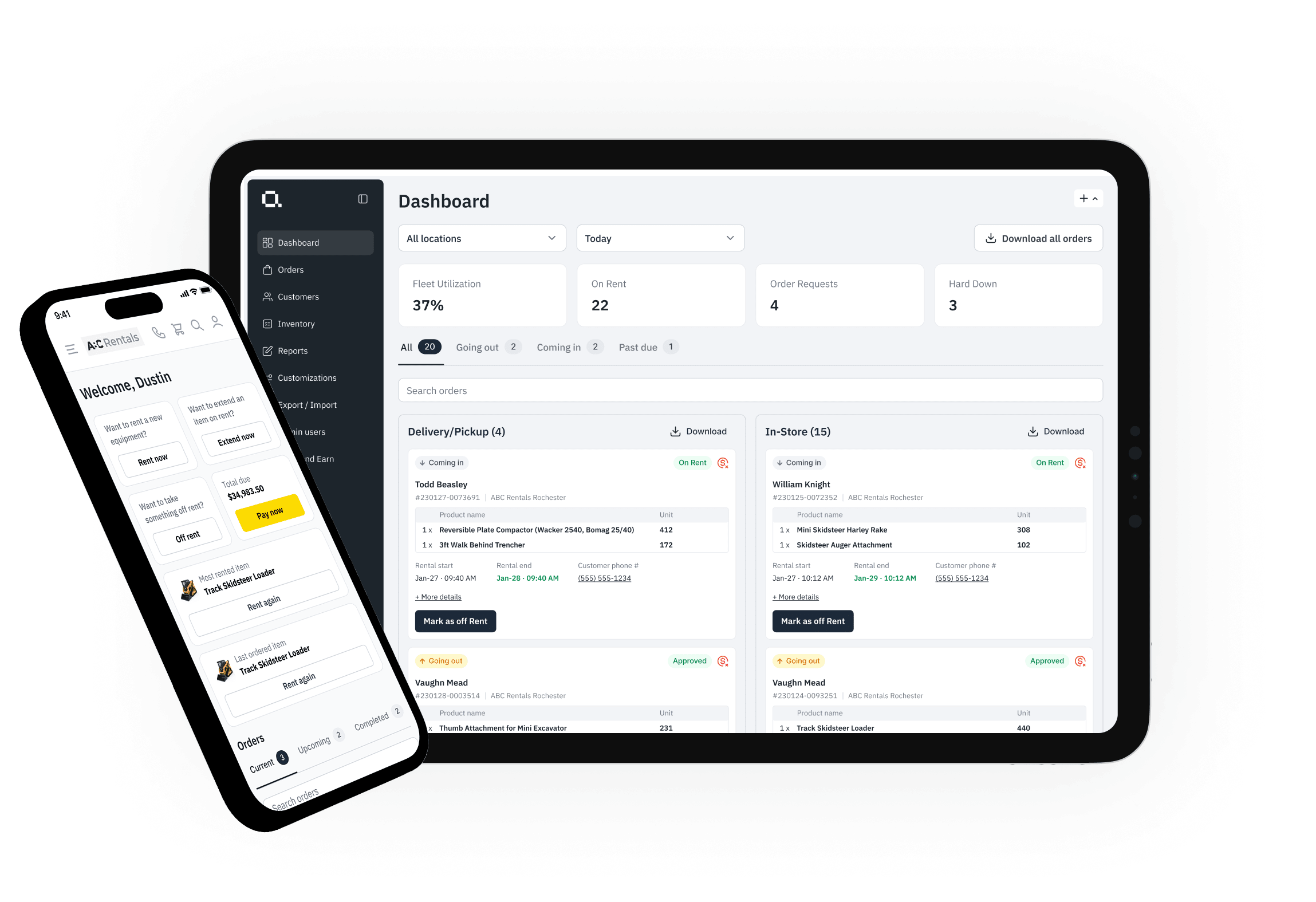
Pro Tip: Systematically offer these add-ons during online checkout with Quipli’s online checkout software features. Our customers typically see a 10% to 15% increase in average transaction value (ATV).
Improving Fleet Performance
As you know from your operations, improving fleet performance is all about equipment utilization rates, how much of your fleet is actively generating revenue.
If your utilization sits below 50%, you’re likely carrying too much idle inventory or experiencing inventory visibility issues. You can solve both of these problems with a couple of different optimizations.
The fix often lies in better inventory visibility. When your front-service staff can’t quickly see what’s available (especially if you run multiple locations), you don’t set them up for success, and rental opportunities get missed entirely. Real-time inventory tracking eliminates these blind spots and lets your team confidently book equipment without fear of double-bookings or scheduling conflicts.
Another overlooked fix for maximizing fleet performance is taking a hard look at your equipment’s appearance. Surprisingly, equipment appearance affects utilization more than many operators realize. Mr. Caparco found that, “…when people see the equipment, and they see it looks good, they actually are more careful with the equipment. If they get a piece of equipment that’s all scraped up and dented up, they’re going to treat it like a piece of junk.”
Reduce Lost Deals and Churn
Ever heard of opportunity costs? Your missed rentals represent revenue that walked out the door. Even a 5% missed rental rate on a $2 million operation means $100,000 in lost annual revenue. Multiply that over a few years and you get the picture.
A great way to reduce lost deals is to ensure as close to 100% equipment availability and uptime as you can. Ensuring equipment availability all begins with proactive maintenance scheduling. To start addressing what equipment categories need better maintenance schedules:
- Begin by auditing the time periods when equipment was down.
- Next, forecast the potential rental rates and revenue you would have received if the equipment had been available.
- Adjust for any lifetime value metrics.
Don’t forget about the customer experience. Customer-facing improvements matter too. An equipment rental e-commerce storefront with real-time availability lets customers self-serve rentals 24/7. In fact, if you have a poor online experience, 49% of customers think that it can translate to your service abilities.
Maximize EBITDA
EBITDA (Earnings Before Interest, Taxes, Depreciation, and Amortization) serves as the primary measure of operational cash flow health for rental businesses. It strips away financing and accounting decisions to show pure operational performance—often used in equipment business valuations.
Consistent processes are essential. When Caparco implemented standardized procedures at Taylor Rental, some long-time customers pushed back. But the discipline paid off.
Caparco states, “My first six or seven months were customers telling me they’ll go elsewhere with their business. But during that time, we were also growing our business and profitability. By the first year, we doubled it. Those customers that went elsewhere weren’t really the customers we wanted.”
Other Tips for Improving Business Metrics
Each input in the calculator represents a specific area where targeted improvements can raise your overall Pulse Score. Here’s how to move the needle on each metric.
Gross Profit
Everyone wants more profit, but make sure you don’t sacrifice the customer relationships that you and your team work so hard to build. Some low-hanging fruit for increasing gross profits includes extending equipment life through:
- Better preventive maintenance,
- Negotiating optimal pricing with parts suppliers, and
- Eliminating unprofitable equipment categories from your fleet.
We recommend reviewing your lowest-margin rentals quarterly and either raising prices or discontinuing those items.
Labor Costs
Your labor typically represents 20% to 30% of revenue for equipment rental operations. It’ll include workers such as counter staff, mechanics, delivery drivers, and administrative personnel. The goal isn’t necessarily to minimize labor—it’s to maximize revenue per labor dollar spent.
One of the best ways to address labor cost issues is to prioritize hiring the best staff who will increase productivity. When hiring, prioritize work ethic over industry experience. The right attitude combined with proper training often outperforms rental veterans who resist new processes.
“Work ethic is the number one most important thing to me. If somebody has a good work ethic and they understand how to work with people, the rest you can train,” says Caparco.
Occupancy Costs
While these costs can be hard to optimize and fine-tune, given that leases and associated costs are fixed and negotiated for 1 to 10 years, the occupancy costs include rent, property taxes, utilities, and facility maintenance. Which should range from 5% to 10% of revenue.
Multi-Location Tip
If you have multiple locations, take the time to analyze revenue per square foot at each branch. An underperforming location may benefit from better store layouts, marketing, or other assistance to boost revenue in line with other places.
Operating Costs
Operating costs like insurance, fuel, marketing, software, and professional services can often creep up over time. Conduct yearly or quarterly audits of your operating expenses.
Utilization
Every percentage-point improvement in utilization translates directly to your bottom line because equipment costs remain fixed.
Improve utilization by right-sizing your fleet based on actual demand patterns. Review utilization reports monthly to identify consistently underperforming assets. These might need pricing adjustments, relocation to higher-demand branches, or removal from your fleet entirely. For consistently high-demand equipment, consider adding units rather than turning away rentals.
Pro Tip: Quipli’s Revenue and Utilization Analytics break down performance by location, product type, and category. This visibility helps you identify which assets generate the best returns and where fleet investments will have the most impact on your overall utilization rate.
Missed Rentals
Sometimes you may not have enough data to fully understand your missed rental opportunities. To get that data, train your counter staff to log every declined rental request, including the equipment type and requested dates. This data will help you find patterns that can inform areas of adjustment.
For example, if you’re consistently turning away requests for scissor lifts on Saturdays, that’s a clear signal to expand that portion of your fleet or adjust your weekend availability.
Use the Peer Executive Group Performance Calculator.
Final Thoughts
Use the Performance Calculator regularly—monthly or quarterly—to track your progress and identify emerging issues before they become significant problems.
Small, consistent improvements across each metric compound into substantial gains over time, transforming operational efficiency into lasting competitive advantage.
Ready to get complete visibility for your general or heavy equipment rental business? Contact Quipli today for a personalized demo and discover how our platform can transform your rental business.