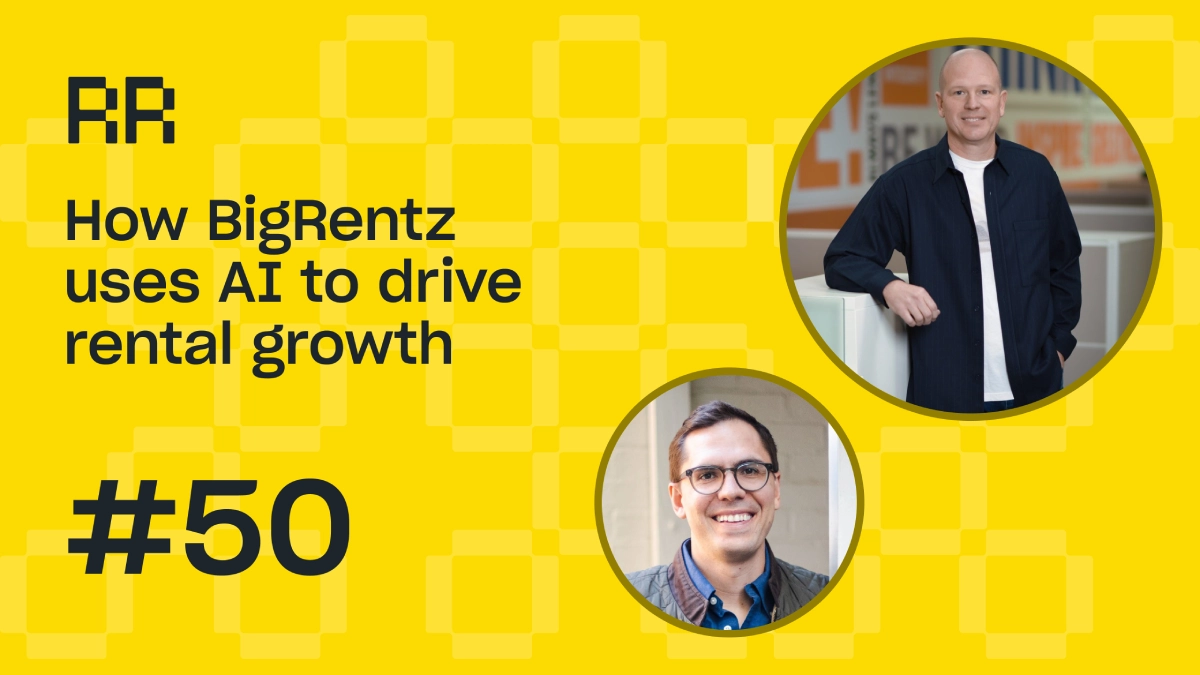
Kyle Clements (00:00):
Hey, rental Roundtable listeners. First of all, I just want to say thank you for being a listener for the Rental Roundtable podcast. We started about two years ago. Today we recorded episode 50, which is 49 episodes further than I thought we’d get, and it’s been a lot of fun. We’re going to keep doing weekly episodes this year and a lot of exciting guests coming on to the show. A lot of leaders in the rental space. For today’s episode, we on Scott Cannon, he’s the CEO of BigRentz. He’s been the CEO there for eight years. They work with 6,000 rental companies in the US, 14,000 rental locations. Talked about his journey at BigRentz, where they started, what they’re doing now, how they’ve really been leaning into AI for many years now. Some of the technology they’ve been rolling out, talking about lessons from logistics, talks about the inefficiency in wasting construction. 90% of construction projects are over budget or off schedule. Talked about labor shortages. Talked about what he’s learned being the CEO now the second time, and what keeps him going, what drives him. So, a really fun episode, episode 50. We made it a lot more to come. Hope you guys enjoy everyone. Welcome to The Rental Roundtable. We have on Scott Cannon, the CEO of BigRentz for episode number 50. It’s a big deal. So we got on an awesome guest here, Scott, no pressure. Thanks for joining today.
Scott Cannon (01:04):
Thanks Kyle, appreciate it. No pressure indeed.
Kyle Clements (01:06):
Yeah, well excited to have you on. Obviously, BigRentz is a stalwart of the equipment rental industry. Reading on your LinkedIn, right, 6,000 active rental companies for 10,000 rental yards in the network today, 90% of job sites can be reached within a 30-minute drive, 98% within an hour. So you guys have scale, you’re talking to a lot of rental companies. I’m sure a lot of our listeners know BigRentz and probably have used big Rent. So awesome story to kind of jump in today. So Scott, for today, I’d love to, if you want to start with your background. I always love to hear about people’s stories, Genesis stories, how’d you get into rental? Obviously, you have a logistics background. Tell me about your story of how we got here today.
Scott Cannon (01:42):
Yeah, thank you for having me on. I appreciate it. And just talking about the 6,000 rental companies that make up our network. The typical rental company is a one to three location, multi-generational business. So I think your listeners are going to be the people that we work with on a consistent basis. I fell in a rental by accident, so this was not something, and then my background was logistics and nobody grows up and says I want to be in supply chain. It’s just something that happens in life. I ran a multinational same-day logistics company that it took over in early 2005, and we used to ship things in time, critical urgent needs. It was the temperature control. There was something unique and special about the shipment. And so think about getting an aviation part from Los Angeles to New York today because it’s hard grounded aircraft.
Scott Cannon (02:34):
That’s the kind of stuff we did. And so that dovetails really well into what we do today because construction, as you know, is time critical. It’s about having equipment and the people and the products where it’s supposed to be when it’s supposed to be and if it’s not roads, thin margins relatively quickly. And I ran that company for up until 2012 and sold it to a private equity group and then stayed on for a couple of years, took a second bite of Apple in 2018, one of the private equity groups that was invested with me, a company account, St. Cloud, had invested with the founder of BigRentz. So not my idea. I think there are probably many better ideas and originally and we’ve grown up over the last decade in terms of what we are and the customers we serve and really have a need that we’re fulfilling today.
Scott Cannon (03:25):
But the private equity company introduced me to the founder. We hit it off and he asked me to come on board and the idea was I was going to show him how to run the company and he would stay within weeks. He put me in charge and here I’m eight years later and it’s been a ride. BigRentz. When I started with the company, a lot of rental companies were unsure of us that we’re there to erode margin per them by taking customers and it’s nothing of the sort. We compete with the national providers with travel and contractors and bring a creative revenue to small independent rental companies.
Kyle Clements (04:01):
I love that. And you mentioned earlier you’re working with the one-to-three location groups. That’s a lot of our listeners, a lot of the people I talked to every single day. I’m curious early on when you started eight years ago, you came in to help coach the founder and now all of a sudden you’re the CEO. One of the narratives I would hear is, oh, the BigRentz or the BigRentz of the world are going to take, my customers are going to commoditize me. How did you fight that and really help grow companies understand, no, we’re actually here to help you and actually help you compete with some of the national players?
Scott Cannon (04:30):
Well, what was tough, and I’ll tell you the first couple of years was undoing that reputation. We partner, first of all, we charge market rates. So we accumulate a plethora of information and we don’t undercut the market. We charge where the market is and what the value we offer to small, smaller companies is the first page of Google is all that really people care about. And you get to page two and page three, you might as well be hidden. It’s the best secret of all time. And so we spent a lot of money making sure we were in the one to three stack in terms of being the first, second or third company that lists for certain keywords and just proven out that, well, lemme back up. What we do for small companies is we indemnify them on risk, particularly for stolen equipment and for damages.
Scott Cannon (05:23):
And as we all know, small customers are the more profitable customers, but they have a lot of friction. That’s where you’re going to see a lot of damage, certain tip, how to use the equipment. And we funnel that into small suppliers and a typical supplier here, I’ll use a guy in Southern California, not by name, but just talking about him last year alone, we brought 450 customers to him that he otherwise wouldn’t have had. And instead of having 450 customers, he now has one customer. And it was very lucrative, very profitable for him. And we automated it as much as we can by using our quick system, which is just a ground sourcing platform, text on his phone, he can claim the order and whatnot. The information’s transmitted over and it’s been sort of frictionless for him. In order to replicate that, he would’ve hired multiple salespeople, had all the admin of bringing those people on board, taking the credit risk and the damage risk and the theft risk.
Scott Cannon (06:16):
And we’ve indemnified and we use a lot of algorithms and a lot of formulas to determine who we rent to and who we don’t rent to, what price to charge and what markets and so forth. And then we sit down with small rental companies and we show them how we price the market and we give them the opportunity to be in different tiers in terms of how competitive they want to be. And at the end of the day, we don’t force anybody to do business with this. It’s a creative, so if you have a piece of equipment sitting in your yard and you want to put it out the rent and we have a need for it, you take advantage of it. If you think you’re going to rent it to somebody else, you don’t.
Kyle Clements (06:50):
So imagine I’m a rental company, one location in Georgia, and I’m hearing this episode for the first time, learning about BigRentz. What exactly is BigRentz? How do I sign up for the service? What does the experience look like? Could I choose certain pieces of equipment to list, but not all? What’s that user flow look like? How do I hear about new orders coming through? Tell me about that experience as a rental business owner.
Scott Cannon (07:11):
So we’re a procurement company at the end of the day, we’re out there looking for a construction and a totality. And as a rental company, you would work with our supplier team determine what inventory you want to put on our platform or not. And one of the unique things that we do is everybody charges transportation differently. Some people have within this amount of mileage from my location, I’ll charge this amount every mile thereafter. It’s a different amount. Some people do it by zip code, some people do it by distance tiers. We do all that every way. You could basically bill a customer we have on our platform today so we can pretty much accommodate any way somebody wants to do business. And what we’ve done is if this was my table, here was the us we’ve gone out and drawn little shapes to represent where a supplier, where a rental company will or will not deliver equipment based on what they tell us, but also based on everybody’s behavior.
Scott Cannon (08:06):
And it’s an AI algorithm. And so we have all these shapes here and a job site is just a pin that comes down and where does it cross over ranges, shapes that people will deliver to and it automatically calculate cost and provides that to the supplier and say, Hey look, we have a need to go to this job site. This is what you say, you’re going to charge us, claim it or not claim it. And it’s really easy. And then in terms, we sit down and do quality assessments on a quarterly basis with people that spend a significant amount of money with us. We’re ISO 9,001. We expect to have the same quality standards across the board. So we invite people on our network that are going to fulfill those as well.
Kyle Clements (08:48):
So I’m a rental company. I say, Hey, I’m going to deliver up to 30 miles and maybe I can draw a geo around me if a job site comes in that’s in my territory. I imagine it’s probably also in some other people’s territory. How do you decide who you reach out to? Do you reach out to everyone at the same time and first response gets it or is there a stack ranking? You kind of go through the list? How does that actually work?
Scott Cannon (09:08):
It’s a stack ranking and it’s not just based on price, based on a variety of factors, how often the suppliers late do they charge us, what they’re supposed to charge us, what’s the expected outcome? And that goes into the algorithm and it’s weighted along with cost and whatnot. And then it’s an a tier system. So the sort of suppliers that are the preferred ones for those are going to get a heads up a clock if you’ll half hour, hour. And then it goes to the next tier and then it basically opens up across the board.
Kyle Clements (09:38):
So almost like if I’m an Uber driver, I have my driver rating and if you get too low, you get penalized, et cetera. So you’re essentially incentivizing good behavior on your platform and the better you behave and charge the price you agreed to and respond quickly and deliver great service, you get more BigRentz rentals. Is that right?
Scott Cannon (09:54):
That’s exactly right. All said.
Kyle Clements (09:56):
Yeah. Yeah, very interesting. And on your background, the other thing I was going to ask about before BigRentz, I saw that you were a division one Cal football player, is that right?
Scott Cannon (10:05):
I should take that off my, yes. I played division one football at Cal State Fullerton the year and a half. I was still there while we had a football team, but I did play with two gentlemen who played in the NFL on that team. And I had my welcome to college football moment if I could give a quick anecdote. I was receiver, I ran a slant pattern, caught the ball, headed back out, made a move on the cornerback who came past me and I see nothing but green and I’m starting to accelerate. And then I get picked up and the whistle blows and the guy picked me up was our nose tackle who ran a 4 6 40. And so I’m 4 6 4 5 and I think a blazing speed I’m get caught for this monster of a man who just picks me up, didn’t even do me the respect of tackle on me. He just picked me up. And at that moment I knew I was done. I was a much better student than I was a football player.
Kyle Clements (11:01):
Was that an N feature? NFL player picked you up?
Scott Cannon (11:03):
It wasn’t, but his brother played in the NFL. His brother was a guy who played for the Bears who had the biggest arms in the NFL. This guy had the bench press record for the state of California for a number of years.
Kyle Clements (11:14):
Wow. Yeah, you were there for the pre NIL days too. So if you play now, maybe you get a little bit of a payment to be on the team.
Scott Cannon (11:20):
A couple of my friends that transferred to bigger schools, NIL existed before NIL
Kyle Clements (11:24):
Existed. Yeah, exactly. It was called something different. We had a guy, one of my friends played quarterback when I was at Clemson, well maybe I shouldn’t say this, but someone you were get paid a lot of money to cut people to grass is what I’ll say, more than the 20 bucks, whatever it used to be.
Scott Cannon (11:39):
The bottom of the list in terms of division one schools, certain players got free meals, got jobs, that was very common as well. So it’s all part of the game.
Kyle Clements (11:49):
Yeah. I should know this record, I should say. Oh, it was definitely my friends at University of Alabama. They were all paying everyone. It’s not where I went to college.
Scott Cannon (11:57):
Stephen’s gone. So I mean now NAL is open, everybody can do it.
Kyle Clements (12:01):
Yeah, yeah, that’s right. Well turns into a college football podcast. That’s my next one. So I appreciate your background. I want to talk about some of the inefficiency and waste that’s happening in construction, right? As you know, 90% of projects, construction projects go over budget or off schedule, like the majority do. It’s very rare for them to be on track. How does embracing modern solutions like BigRentz, help keep things on track on time and on budget?
Scott Cannon (12:24):
Well, I mean that level of inefficiency would not be accepted anywhere else in any other industry. It’s something that’s got to change. I kind of look at construction. If I’ve drawn a chart of construction, I’d bifurcate in two halves, sort of the massive general contractors that are actually profitable, very profitable, and then all your specialty subs, your hvac, your electricians, your plumbers, all the specialty trades, it’s not as efficient and the productivity doesn’t gain as much. It lags other industries. So productivity gains are one and a half to 2% a year. We see much more dramatic productivity gains in other places, and the EBITDA levels are traditionally single digit. So if you have a piece of equipment not show up when it’s supposed to or an electrician fails to show up or the materials fail to show up, it aeros the profitability immediately and the contractors typically upside down and that’s a very bad place to be. So one of the things we want to do is we want to control the cost and experience for our customers.
Scott Cannon (13:29):
And it’s not always driven by having the cheapest price on a piece of equipment. It’s about having the things show up when it’s supposed to and having at least friction as possible so they can get through that onto the other jobs. The majority of our customers are traveling contractors, meaning they’re going to do business in multiple different places. Instead of picking up the phone and calling 50 different rental companies and having 50 different relationships, they’re able to consolidate that into one supplier, us and then we use the tools we have. So we built, maybe let’s just slow it down a little bit. So our system is built around artificial intelligence. We have a model that looks at, it’s a supervised learner model that’s taken half a million contracts, rental contracts into play and learned on, and we have probably another half a million to 750,000 opportunities that’s basically learned on.
Scott Cannon (14:18):
So what can the high level predictability predict who’s supposed to be used on a project and who’s going to perform and the characteristics of who we need to use to do this. And in the architecture of the way we created our system, we took every bill and method you possibly could. So not just the day, week, four week, but we also took into consideration purchases and hourly rates and so forth so we can address all of construction, not just rental equipment but also materials and people. And that’s something that’s unique to our platform that we’re going to expose later this year. But that system is how we control that. We typically save customers 10 to 15% on cost and then another 10 to 15% of lost time. So about a third of a construction week is spent on non-optimal things like searching around where’s my piece of equipment, what’s going on with this? Or I need a new contractor because I’m going to a new city. We wipe out that and we just become much more efficient and use our platform.
Kyle Clements (15:27):
So I can imagine, I’m a traveling contractor, I work across maybe whatever, five, six states in the southeast rather than show up in Charlotte, North Carolina, and I’ve never been before and call 30 rental companies. I just go to BigRentz who’s already done the work for me and stack ranked. All I say is I need this piece of equipment at this job site on this date. You guys are already, your algorithms are looking at who’s going to be the best fit for that individual rental transaction and putting that at the top. Does the renter then have to go call number one, two, and three on the list or are you guys doing that for them and all they know is rental company A, B, C is dropping off the equipment,
Scott Cannon (16:01):
That’s it. It’s a one-stop shop. So the rental agreement is with us and then we indemnify the supplier, but at the same time we hold the customer accountable. So we’re unfortunately stuck in the middle. We’ll be providing the way we do it around our business, we’ll be taking that software and exposing it in a SaaS model for customers to do it themselves. Some customers want that control. So there’s many customers that have given us all their revenue and sort of understand if I aggregate this and some places rent’s going to be a little bit more expensive and other places are going to be dramatically less and you sort of wash it out and it’s kind of a wash and you just give it all. Then there’s some customers in construction that want to cherry pick and they want to say, well, I want to use the cheapest person here and the cheapest person here and cheapest person there, I want out of that game. So we’re basically going to give our software and let people do that for themselves so they can put their own rates in the software, run it themselves, and where there’s not an option, BigRentz will basically show up and they can get both the best worlds.
Kyle Clements (17:00):
So some people like to cherry pick and they’re, they maybe have more time than someone who’s just like, I’m just going to use BigRentz across the board. It saves me a lot of time. Some people would cherry pick and what you’re saying is they can put those rates in and it’ll just say, look, we don’t think you’re a good fit here, but over here it is and you guys are doing all that work for them. And would that be a SaaS model that the renter then subscribes to?
Scott Cannon (17:21):
So that’s one of the evolutions of BigRentz become a multi-platform company. So have, if you think about where the company founded was on small mid-size companies, little tiny contractors, and that’s sort of our marketplace. And then in the middle we have a BigRentz plus product, what’s really meant for mid-market and enterprise level contractors. And then we’ll have the SaaS model and all three of them are basically supported by the same platform.
Kyle Clements (17:46):
Yeah, well welcome to the SaaS world. It’s a great business model. That’s the one I’ve been in for a while. And going back to your initial point, 90% of construction products are not on budget or on schedule like we talked about earlier. We’re going to the hospital tomorrow for my wife’s baby due. I can’t imagine if 90% of deliveries are, baby deliveries are on time, on schedule or health. You know what I mean? It’s like medicine is obviously the other extreme version of that, but for some reason construction, it’s just people just accept it. I don’t know if you have any thoughts on that. Why as a country which is accepted that 90% or put differently, 10 having a success rate of 10% of projects on time, on schedule, that’s good. Or why do you think that is?
Scott Cannon (18:29):
I think it’s just the evolution of where the industry is. I go back to my logistics space. When I started in logistics, the company I ran had a massive whiteboard that ran the gamut of the entire floor and it had 12 pieces of 24 pieces of electrical tape to designate an hour across the board and tickets were printed out with a magnet and thrown on the board. And then the next job step was basically put there within four to five years of coming into that. I ripped that board down one time because we had a new software that basically automated all that. And by the time I left the space, we were integrated with airlines, we were integrated with suppliers and 80% of the orders were frictionless, meaning that they came in automatically, they were dispatched automatically. The lifecycle of the shipment was handled automatically and the 20% were sort of the edge cases.
Scott Cannon (19:17):
There’s no reason in today’s today’s world that it can’t be the same, particularly when we’re talking about commonly used pieces of equipment that are ubiquitous everywhere. If you talk about majority of aerial and material handling and then some of the light earth movement equipment that’s everywhere, it should be a consistent experience. And I think it’s just, if you look at the fragmentation of the space, there are just thousands of companies that make up still 65, 70% of the space is made up over smaller accounts. Once you get past the big guys, three or four, it drops off in terms of revenue and you just get a different experience I think because it’s always been that way, is the way it is. And where you see companies with introduction of new technology, AI, and I know it’s overblown and it’s usually underwhelming when you actually see what people use it.
Scott Cannon (20:10):
It’s a good buzzword, but the reality is it’s a tool just like a shovel or anything else, and it’s something that probably should be used more into space. And we’ve seen adoption. When I started with the company, it was a real struggle to get upmarket contractors to support us and to want to do business with us. And we are seven years later and they’re our biggest champions. They make up the vast majority of our revenue and it’s just having the option available. Construction tech, it’s been an evolution. There are three or four or five big construction tech companies that have really done it and done quite well that are publicly traded or private equity and then there’s everybody else. And I think you have to get to a certain scale before you get taken as credible and people start to embrace it. And I think a lot of the work that companies like yourselves and I’m doing, I think we’re getting to that place where it’s more commonly accepted today.
Kyle Clements (21:03):
Yeah, for sure. I’ve been in the rental industry four and a half years, got pulled into it sort of myself. You’ve been in over eight years. How have you seen the rental industry evolve, particularly around streamlining operations efficiency, maybe using technology? How has that changed in the last eight years and maybe are there any parallels to what you saw happening in logistics before BigRentz?
Scott Cannon (21:24):
Well, nobody had systems and logistics. They were using paper. And when I started almost eight years ago now, I talked to rental companies that you’d call and ask ’em if they had something available and they literally say, hold on a second and stick their head out the window and go.
Scott Cannon (21:42):
And I’d say the vast majority of companies that we do business with today have some type of ERP that’s different. I’ve seen much more embracing of technology. Telematics was talked about when I first came on board and the logistics have been used for years. We were one of the first companies to work with FedEx to put GPS technology on commercial flights. And that was a huge deal in 2010, 24, 25 now. And I start to see companies now embrace that and create data, little data warehouses around the different systems. Some of the telematics doesn’t talk to ERP and some of ’em have dispatch and software and they kind of put a cluster of these things together. But I don’t think it’s in the best interest of multi-generational businesses to ignore technology and not lean into it because the big companies in space has spent a heck of a lot of money embracing that technology. And they’re very good companies, very well operated, and if people want to be able to pass their company on to the next generation, they really need to step into it and lean into it to do it successfully. Not necessarily jump in the pool, but at least put your toe in the water and understand that it’s a resource.
Kyle Clements (22:55):
Couldn’t agree more. I mean we talked a lot of groups also. It’s like, oh, we’ve always done it this way. We’ve been doing this 60 years. Why do I need to go from pen and paper to whatever rental software or BigRentz? Why do I need to migrate my 40-year-old server? And it’s like obviously I think it’s in some sense, well you right, you’ve done it for 60 years so you probably don’t need to change. But I also would say that technology is changing faster than we can comprehend. And the nationals are very sophisticated, very smart, spending a lot of money on this stuff, and they already have a leg up with some of the scale they have. And I know the independents can’t out hustle them and they do and they offer amazing service, but times are changing quickly. Even from me looking at this in 2020, the big thing was can you put pricing on your website and do e-commerce?
Kyle Clements (23:41):
That’s sort of crazy that that was our wedge into the market and now everybody’s doing it, but that shows you where the market was and how quickly it’s evolving. And I think in some sense there may be more disruption in the next five years in technology and particularly for rental companies than there were in the last 50. And people are going to say, that’s crazy, but it’s moving so fast monthly things are moving fast. I don’t know if you have that same view, but it feels like the time was yesterday to start investing in some of this.
Scott Cannon (24:06):
My CTO was telling me, we were talking yesterday, we’re building sandcastles, not real castles. So I’d never heard that expression before, but I mean at the end of the day, none of us know what technology’s going to look like five to 10 years out. We do know it’s going to change and it’s going to be disrupted and the things that we’re building today are going to have to evolve. You mentioned that, just a pricing on our website. I want to go back to that if I could. One of the values for customers for us is if you look at price transparency, and I think your background, you had experience at Uber, and so one of the values of Uber was can I have transparency and cost and do I know the availability of where that taxi cab driver is going to be? And one of the things we were able to do here for our customers is everybody charges slightly different.
Scott Cannon (24:53):
And if you look at the day, week, four week, there’s no linear relationship from one supplier to the next in terms of where that free rent is. Is it 2.4 days before you get to the week? Is it three days and so forth? And it’s very confusing the customers. Then transportation makes about 40% of the cost of a typical rental on an A LV under $2,000. And that’s not transparent to the customer immediately. Now there’s benefit to rental companies and that lack of transparency because it drives margin. But if you’re a big contractor who’s trying to do work across the board and you really want to understand it, understanding that relationship and what the cost really is all in is really important. And when I talked about AI earlier, it’s not a theoretic, it’s practical. If you go to a website and you put in the job site location and you put in your dates, it’s actually calculated on the fly using models and distance down to the exact job site location today. So that’s something that nobody does. You can do it with one of the big guys. You can basically do that with almost. But we’re the only ones that basically have that and that drives customer loyalty. And that’s something that small rental companies to have those tools to be able to share with customers and let them pick and choose as they want to go to your platform and basically book online and understand the whole cost so there’s not a disappointment later. That’s something that’s changed significantly over the last five years.
Kyle Clements (26:17):
So do you think rental companies need to be putting prices online and is that in all cases, and if they are putting prices online, you’re saying that they should break down the specific, here’s the delivery costs, here’s your Colorado state tax, here’s your Denver City tax. I mean, should they break out every single wine item? I mean, how should rental companies be thinking about pricing transparency?
Scott Cannon (26:38):
Now I say that and then I’m thinking my business model solves that on a local basis. I don’t know if it’s necessary for the small infrequent renter. Yes, I think the prices should be online and yes, you should put your sales tax and let customers basically check out. That’s the experience we all get with anything else. So you should be able to do that today. And the technology is not unattainable. There are a number of platforms that basically have that technology, I know your platform does, and these are things people need to embrace at a national level. It’s a lot much more complex. So what we’re doing is as an aggregator, it’s not just taking your own, you got to do others. But yeah, I think suppliers should do that. I think around companies absolutely should be transparent. I think customers expect that.
Kyle Clements (27:28):
Yeah, and I think what we’ve seen is people, what they experience in their B2C life, they’re expecting their B2B life. So if you order a coffee on Dunking Donuts and you see the exact price, you click a button on your phone and you order an airline ticket and it changes with dynamic pricing. And people are used to that. They want pricing transparency. They don’t want to click, okay, I want this skid-steer for next week. Call for a quote and just tell me what the price is. Episode 48, we had on an accountant who only works with rental companies and she was saying she put pricing on her website for her accounting services and her business sort of skyrocketed because people love the transparency. It’s very clearly you’re a fit or you’re not. You don’t want to pay this much money. Okay, great, well we’re not even going to waste time on our conversation.
Kyle Clements (28:09):
But the fact that you are putting the pricing out there with your 1, 2, 3 packages, it was just very refreshing. And we did the same thing because last year I was telling Rev companies got to put pricing online and then it just woke me up one day. I was like, we don’t have our pricing online. So we took our own medicine and November 1st we did that and it’s been so refreshing. One price, it’s very good. Our website look at it. And our business has done well because of that too. And I think that people just want that. They want trust, transparency. People sort of know what they want. They know what they want, they know the price range, they want to do it, and all things being equal. If someone’s got the transparent pricing, I think they’re going to get win more business long term. Otherwise, you feel like it’s a negotiation and yeah, the price may be X, but is it 20% higher because I didn’t negotiate with you and I don’t like buying used cars. Tell me what the price is. Right?
Scott Cannon (28:54):
You also don’t want to waste time. So one of the things I noticed as a company, we were getting flooded with phone calls when I first took over. I’d rather people self-select out. So let’s get the type of customer that we actually want to have and if they’re not willing to pay what I want to charge, why am I wasting my time haggling with these people? And I also say the people that are going to the haggle over a tiny little difference in price are going to be your worst customers anyway. You might as well. That’s how it is.
Scott Cannon (29:18):
Walk that nonsense out, deal with the people you want to. And it’s not about price shopping so that somebody can go look at a competitor. It’s more about the comfort that you’re doing business with somebody with integrity that’s telling you what you have to pay.
Kyle Clements (29:31):
Yeah, here’s the price that works for us and we’re going to be very transparent about it. If you like the service and that price works for you, let’s have a conversation. Right? It’s just very out in the open. It’s very refreshing and that is part of the future. Tell me a little bit more about AI. In some sense, AI has been here for 60 whatever years and I was just in a peer group meeting earlier today with eight other software CEOs and the question was, how many people are using AI in their business today? Software companies and all eight are right now. It’s like every software company’s doing something with AI today. How long have you guys been on this journey? Because if you asked that question three years ago, not many people would be saying they have AI in their software.
Scott Cannon (30:04):
So because it’s being videoed, I’m going to show you something funny. This journey started in 2017.
Kyle Clements (30:11):
Alright. Yeah, way ahead of the curve.
Scott Cannon (30:14):
Ahead of the curve. So one of the things we did when I first came in the company was a lot of paper and I just poured through data and I saw that we could cluster our data, the pricing that we had basically divided by a number, it doesn’t matter what number and then we could actually cluster tiers. And so we started the process manually in 2017. We went to a sort of hybrid model in 2020. And over the last two to three years, we’ve gotten to the point where the math is so complicated, it’s above my capability. I can tell you what the model’s doing, I can tell you how it’s rationalized, what the positives and what the negatives are, but I can’t tell you how I actually do the calculations. So we’ve had this AI model running in the background for the last three years, but our software launched on January 4th, it’s now native in the system and it’s basically running the decision making for our agents today.
Kyle Clements (31:13):
How has that impacted your customers? Why do your customers, I made some sense, they’ve done studies and they’ve said, Hey, we have this AI feature versus it’s marketed as hey, this will save you 30% of your costs, et cetera, and that drives a lot more click through and higher engagement. Why does the end renter or a rental company care that you guys are using AI.
Scott Cannon (31:33):
Faster, better and more transparent decision making. So just letting people have the tools. We can calculate a price on 99% of the items we rent today within a millisecond. And there’s no email, there’s no telephone call. It’s driven by science. And if we launch a new area, we can fill in the gaps of what we don’t know based on how other places that look similar to that basically provide and how other items similar to that basically are sold. And then look, it’s about saving time and effort and money and the model will be open to materials and labor at some point too. So you look at rental is 60 billion, 65 billion. US construction is 3 trillion. So we’ve exponentially opened our addressable market in terms of who can use our product. We built, because we’re not a pure rental company with a logistics portion of how things are moved, we’ve had to build an entire lifecycle into our software that’s native to people that are doing things with multiple different suppliers on the same job site.
Scott Cannon (32:39):
So we can aggregate suppliers on a job site basis and so forth. These tools don’t exist. You have companies that have worked on scheduling or maybe on some procurement of certain items, but nobody’s really pulled it together in the sort of connective tissue we have. So that’s unique about us and feedback we get from customers is I just want my quote today so I can quote better to my customer so I can win more business. And that’s the other thing on the pre-construction side, we’re starting to partner with people like permit flow and whatnot to get on the front end before you’ve even made the bid, we’ll give you the cost information ahead of time so you can make a better intelligent decision of what to charge your customer so you can win more business and you understand your costs on the backend a little bit better.
Kyle Clements (33:22):
So ultimately improving the customer experience. Obviously you got software engineers part of BigRentz. Is it improving your pace of software development as well using AI internally? Are you able to push code faster and new features, automated testing? How has that improved your internal efficiency building software?
Scott Cannon (33:38):
Yeah, we’ve done that too. So about 25% of our code today is written by ai and I imagine that’s going to increase a little bit. I think there’s never going to be a time where software engineers are replaced. In fact, the value has gone up in terms of people that understand the domain and have the experience of how to wield that tool. We use it in our marketing, we use it in our business operations, we use it at some of our accounting. It’s used across the board. I use it daily in terms of just sort of thinking. I’ve trained my model up to the point where it’s an intelligent graduate student who can converse the topics I want to talk about.
Scott Cannon (34:16):
And it took a year and a half to get it to the point where it understands all my nonsense and understands where I’m coming from and how I respond. And it’s not something to be feared, particularly in our industry. If you look at construction and this data I said I’ve seen before is only 6% of jobs in construction and maybe four or 5% in facilities management can be eliminated by AI as opposed to retail where you’re going to see 65% of IT construction and construction related materials. This is a tool in the toolbox. It’s not a replacement for people.
Kyle Clements (34:52):
I’ve been using AI personally for a few years and I’m training my own model. It’s currently sixth grade level, but maybe it’s just learning from me. I need to get Scott to train it. No, it’s definitely the future and I think the future is bright in technology and for rental companies in particular. I think a R came out, I was at the show, the future rental stuff. They said $60 billion industry 2021 this year they’re protecting get to 83 billion and we’ll cross a hundred billion in a few years. So it’s great for rental companies and a lot of tailwinds behind the industry. It’s growing faster than GDP on the AI side. How should rental companies be thinking about this, right? They’d say, let’s just say they’re on a legacy rental software, they just upgraded to a new version and they’re still not necessarily leading the curve on where the future of technology is. AI sounds about 500 years away from where I am today. How should round companies be exploring ai? You mentioned dipping the toe in the water. How do they think about that?
Scott Cannon (35:45):
That’s a great question and I’m going to say I’m not maybe the best person to give advice on that because we’re a little further down the path in terms of embracing it. I would start small, I’d start using just an AI model, the stuff off the shelf, the free stuff, maybe pay the upgrade of 30 bucks a month or whatever and start to speak to it and share information. It’s not confidential, so don’t share customer information or vendor information, but refer to them in terms of sequence or numbers or some type of anonymity. But that’s where I would start. And then I would start embracing the technology that’s there already. If I didn’t have an ERPI, basically I’d go get one and then start using the tools that are available there. There’s lots of options embedded in those products today that would add more incremental benefit than necessarily ai. I’ve just maybe be aware of it, spend time playing with it. They’ll go out and hire a bunch of engineers and spend money go broke really fast. Maybe that’s where it starts.
Kyle Clements (36:48):
And I think obviously rental companies don’t need to go hire software engineers unless you want to burn a lot of money. It’s a great way to do it. But even just the cost of helping AI functionality. Now, like I said, everyone in my peer group of eight other, everyone’s doing it. We’ve got some off the shelf, very cheap. You can get AI functionality today. Three, four years ago you were spending a lot of money to get some PhD from MIT to do, and the cost of delivering AI functionality is dramatically lower, which is ultimately going to drive even faster adoption, faster innovation. It’s the future. I mean, you’ve seen all the changes that I’ve seen in our life, internet going from server to cloud, going to mobile, social media. I mean, how does AI rank in terms of just general impact coming in the next five to 10 years?
Scott Cannon (37:36):
So I don’t want to overstate AI’s impact because I don’t necessarily drink the Kool-Aid a hundred percent on ai. I think a lot of it’s overblown, but I do look at AI as equivalent to the internet is the disruptiveness in terms of, I mean it’s going to change a lot of things. It’s going to change search. Instead of Google search, you’re going to have AI basically telling you. So you’re going to have to be optimized for AI search and make sure that the models understand your business model so that you can get visibility. It will replace a lot of mundane, repetitive tasks, but it does have hallucinations. You got to really pay attention to the response. I wouldn’t trust it to give me medical advice or legal advice, even though it does a pretty good job of it. But there you have no margin for error. The internet I think is the equivalent. I think it’s a next, it’s going to make it that much more efficient. But as the internet did, it created much many more jobs than it basically got rid of. And I think AI is kind of the same thing. It’s a job creator, a net creator, not a disruptor.
Kyle Clements (38:44):
Yeah, that’s an interesting view. I would agree with that also. Not everyone would, but AI actually will create more jobs than it eliminates. Cause everyone talked about the fear part, it just eliminated another job. It’ll create new sectors that we’ve never even thought about. The fact that social media, we talked about social media, that wasn’t a thing until the internet and think about how many jobs that’s created. So I’m excited. We’re on the AI journey too. We’ll just see where it goes. I’m excited for it. Last topic I want to talk about here is labor shortages. And I actually had some beers with friends last week who both are contractors and they’ve been talking about they cannot find reliable good people. As an industry, do we bring people back to the trades and it feels like we’re almost going the wrong direction. How do big brands bring quality people back to the trades?
Scott Cannon (39:34):
It’s a great question and I think if I had an easy answer for that, we’d all be rich because everybody’s been trying to solve that problem for years.
Scott Cannon (39:41):
I think I saw some stats at the, there’s like five plumbers retiring for every one plumber that comes back in or something like that. It’s really amazing. The next five to 10 years, the shortage of qualified contractors is going to be a really big problem for this country. I have five children and my three older ones are now graduated from college and they’re doing fantastic. And every one of them I told to go into the trades instead of paying private school education that they got. It was an amazing education experience, but they all got out making wages that were comparable to what I was making when I got out of college. And it didn’t really advance the, there’s no future in some of these jobs, just future and trade. I mean, robotics is really cool, but I’ve never seen a robot that can basically replace a roof and do electrical work, not that’s cost effective. And I think making the trade sexy again, when I was a kid, everybody was told to go to college, but my family came from blue collar background. My grandparents on my mom’s side were farmers, small business people worked with their hands, mechanics all were highly versed in terms of construction skills. And that’s, as I see my cousins and people, my generation, it’s almost all been lost.
Scott Cannon (41:02):
It’s really sad and it’s something that needs to be addressed or we’re going to have a real problem as an industry. I mean, it’s great to have all this construction work, but if we don’t have the people to do it, it doesn’t really matter.
Kyle Clements (41:10):
Yeah, it’s interesting about the five plumbers leaving, one joining. That’s not maybe a problem necessarily that we are going to solve. It’s a national problem and it’s real though. I don’t know what the solution is. It’s above my pay grade, but it’s something that rental companies are thinking about and obviously they do their best to find great people and they retain. The biggest thing is can you retain great people too? Right? That’s a lot easier, a lot cheaper than to find new people at the time. And maybe you can use technology too to supplement, right? That’s not going to be the silver bullet, but can it fill one or two open spots by just being more efficient using technology? That helps a little bit. So I think those are some of the things that I’ve been thinking about. There’s a couple more final questions. What’s the future for Big Rent? Sounds like you guys, you’ve been in this eight year journey, you’ve sort of taken the binder of really thick paper and now you move towards AI algorithms. What’s the next few years look like for big rent?
Scott Cannon (42:00):
One thing I’ve learned about this space is scale matters and without scale it’s really hard to make money. So you’ll see consolidation within there. There’s a dozen companies around the world that have started what Big Rent started all raised about the same amount of money we’re the furthest in terms of revenue by far, but you’ll see consolidation in that space. I think opening up into trades and materials will be sort of the evolution of BigRentz next instead of just focused just specifically on rental, which is the hardest of the homes. So it started with the most difficult and kind of go into the easier paths. And there’s other companies in those spaces that are flourishing. I think you’re going to see us parlay into that. And then for myself, probably another four or five years and then off to the next a venture, and we’re building a hell of a team here. We have some really solid people that have groomed and developed over the last five, six years. And when you’re a startup, you have to do it like the Oakland A’s, it’s money, but you have to get people in there didn’t necessarily have the experience necessary. But we’ve invested heavily in our people I and just seeing some dramatic growth. And as somebody who runs a business and my second business as CEO, the thing I get more joy out of is seeing the development of young people into mature, really talented individuals that can take those skill sets and go employ them for their family for the next 15, 20 years and create wealth for themselves. That’s been one of the really cool things about running a company is getting to do that.
Kyle Clements (43:39):
That’s awesome. I was planning to ask this, but I’m a first time CEO here. What have you learned the second time around? What are some of the lessons you learned the first time that you wish you knew ahead of time? You’re obviously a new person, you’re now eight years into the second role as CEO. It sounds like you’ll do a third role at some point in the future. What have you learned from your first stint as CEO
Scott Cannon (43:58):
Stay retired? So when I sold my first business, I’d made enough to basically never have to work another day in my life. The idea was not to come back
Scott Cannon (44:08):
And then sort of got talked into it. And I love the people that basically work here. Nobody’s successful in life without a significant amount of resilience. And I think if you went and talked to all the people that run companies, including our supplier base, all these rental companies that are multi-generational, they’ve had to overcome obstacles that are incredibly difficult, whether it be personal work related or whatnot, and have continued to want to get up and come to work and grind it out. And there is no easy linear path to success. It just takes time. And every time you get knocked down, you got to get right back up and go right back at it and just maybe duck the next time instead of take that hit. And I think it’s just a repetitive lesson of learning how to live your life and just get through it and move on to the next day.
Kyle Clements (44:54):
What drives you now? You mentioned you don’t have to necessarily work. You’re still out there grinding, getting up early, doing, we did three podcasts this week. What keeps you motivated?
Scott Cannon (45:04):
I like solving difficult challenges and problems. And if this was easy, I would’ve been out of here a long time ago. And I think that’s what keeps me up at night is the iterative process in my brain where I can’t let a problem go and I want to basically solve it the next day. And the things we’re working on are incredibly cool and it’s something that I’ve always wanted to do and I wanted to do from the day we got here. And it just took time to give us the opportunity to basically get to it. And that’s going to keep me excited for the next couple of years. And then when it becomes easy and it’s just a platform that’s so big and we just order takers, we’re not actually grinding anymore. I’ll let somebody else do it and I’ll move on to the next thing.
Kyle Clements (45:45):
Yeah. Well, I keep bringing up my peer group. We meet monthly. I just had that today. And one of the lessons I’ve learned is 99% of the time these guys who start a company or CEO of a company for a long period of time, and they retire, they go to the beach for about a couple of weeks and they’re like, I got to get back in the game, right? I’m going crazy. So if you’re wired a certain way, I think I’ve got a long journey ahead with quickly, but I’m the same way. I just love it. I love the challenge. I love the impact you make, right? You create jobs for people. You see people kind of move through your organization and grow. You see what you’re helping, how you’re helping independent rental companies, family owned businesses run their business better. It’s so rewarding. Yeah, it beats us fun and we’re going to go to the beach this summer, but it’s boring. It doesn’t get me out of the bed,
Scott Cannon (46:26):
Kyle, after the first month, you’re sleeping good. It’s all fun. And then you look at your phone and it’s not raining and there’s no email and there’s no urgent need that has to get fixed today. That’s actually a very lonely feeling. It’s better to be sort of connected into it on a thing. And I’ve learned better boundaries too. That’s the one that I have learned from being CEO first and second and having a big family is you got to carve out time for yourself and the things that you into your life otherwise without a healthy balance. And nobody’s really terribly successful being a hundred percent balanced. So it’s impossible. But to the extent you can, that’s a life lesson. I learned hard way.
Kyle Clements (47:03):
That final question on promises here. What’s the best piece of business advice or some good business advice that you’ve gotten that’s helped you in your career? It’s helped you shape your approach to building BigRentz?
Scott Cannon (47:13):
I don’t know if there’s one piece of advice I’ve gotten that was transformative. This is more of a deep thought here. Nobody’s going to come save you at the end of the day. You got to figure it out for yourself and pull up by your bootstraps and grind it out. And where you don’t know, rely on people that do, but always be prepared to do it yourself if you have to. I don’t know if there’s one thing said, I think that’s kind of it. At the end of the day, if you want to be successful, it’s going to happen because you, yourself and you’re way more capable of what you believe. If people think you can jump this high, I’m telling you, if you keep working at it, you can jump that much higher. And that’s what I would say. And I think most people that have sat in the chair for a long time, they sort of get it.
Kyle Clements (48:02):
Yeah. Government’s not coming to save you, your bosses that come to save you, your neighbor’s not coming to save you. If you’re going to be successful, you’re accountable for that success, right? And you’re driving it. So I think I saw an article about that last week, actually, so it’s funny you said that. I read. Perfect. Similar. Yeah. Well, Scott, it’s been awesome having you on here, episode 50 for the show, and really awesome to hear your journey with BigRentz in the seven, eight years you’ve been there. And show this future embracing ai, some of the other enhancements you guys are looking at. Obviously working with 6,000 rental companies in the us, 14,000 locations. A lot to be proud of, Scott, and really happy to have you on the podcast today.
Scott Cannon (48:35):
Thanks, Kyle. Congratulations on the 50th.
Kyle Clements (48:39):
All right, thanks Scott.